Quick answer
Should you choose a travel eSIM or a local SIM?
Choose a travel eSIM when you want to prepare mobile data before departure, connect without finding a shop after arrival, keep your home line available on a compatible dual-SIM phone or use one regional bundle across several destinations. Choose a local SIM when you need a local phone number, are staying for a long period, have a phone without eSIM support or find a local plan whose allowances better match your needs.
Neither option is automatically cheapest or fastest. Compare the complete plan, coverage, validity, phone compatibility and setup requirements for your actual trip.
Best choice at a glance
Match the connection to the trip
- Short trip: travel eSIM is often simpler
- Long stay: compare local plans
- Local number needed: check local SIM options
- Several countries: check regional eSIM coverage
Check before choosing
Your phone and trip decide
- Confirm the phone is unlocked
- Confirm eSIM compatibility
- Check calls and SMS needs
- Compare complete plan terms
What is the difference between a travel eSIM and a local SIM?
Both options can provide mobile data from networks in the destination. The main difference is how the plan is purchased, prepared and managed.
Local SIM
Purchased from a provider serving the destination
- The plan comes from a local mobile provider.
- It may be a physical SIM or a local-provider eSIM.
- It may be purchased from an airport counter, shop, kiosk, website or application.
- Registration and identification requirements vary.
- The plan may include a local phone number, calls or SMS.
- Validity, top-up rules and roaming coverage depend on the provider.
Travel eSIM
Purchased online and prepared before the trip
- The traveller buys a prepaid travel-data bundle online.
- A compatible unlocked phone is required.
- The reusable eSIM profile can be prepared before departure.
- The travel eSIM is selected for mobile data.
- The home line can remain available on compatible dual-SIM phones.
- Future eSIMbundle data bundles can be added to the same installed profile.
A local SIM can also be an eSIM
The word “eSIM” describes how a mobile plan is stored on the phone. It does not automatically mean the plan is a global travel product. A mobile provider in the destination may also sell its own plan as an eSIM.
Travel eSIM
- Purchased for travel
- Usually data-only
- Often available before departure
- May cover one destination or a region
Local physical SIM
- Purchased from a destination provider
- Inserted into the SIM tray
- May include a local number, calls or SMS
Local-provider eSIM
- Purchased from a destination provider
- Downloaded digitally
- May still require registration, eligibility or local-provider verification
The correct comparison is not simply digital SIM versus plastic SIM. It is a prepared travel-data service versus a plan purchased from a provider serving the destination.
Travel eSIM versus local SIM at a glance
The table below compares the practical differences travellers normally need to consider. Exact local-provider rules and plan features vary by destination.
Local SIM: A plan purchased from a mobile provider serving the destination, as a physical SIM or local eSIM.
eSIMbundle: A prepaid travel-data bundle prepared online, with VPN access included at no extra cost.
| Capability | Local SIM | eSIMbundle |
|---|---|---|
| Purchase timing | Depends on the provider and sales channel | Can be purchased before departure |
| Connection after arrival | Depends on purchase and activation | Prepared in advance and selected for data |
| Physical SIM swap | Required only when using a physical local SIM | No |
| Local phone number | May be included | No |
| Ordinary calls and SMS | May be included | Continue through the home line |
| Keep home line active | Depends on the device and SIM setup | Possible on compatible dual-SIM phones |
| Registration requirements | Depend on destination and provider | Online account and order process |
| Multi-country options | Depend on local-provider roaming | Country and regional bundles |
| Reusable for future trips | Depends on provider validity and account rules | Reuse the installed profile and add bundles |
| eSIM-compatible phone required | Only for a local-provider eSIM | Yes |
| Unlocked phone required | Yes when using another provider | Yes |
| VPN access included | No | Yes |
| Guaranteed cheapest option | No | No |
| Guaranteed fastest option | No | No |
Compare the complete plan rather than the SIM format alone. Coverage, speed, registration, local-number support, validity and prices depend on the selected provider and destination.
When a travel eSIM is the better choice
A travel eSIM is strongest when preparation and simplicity matter more than arranging a local mobile account after arrival.
You want mobile data prepared before departure
The profile and bundle can be prepared while reliable internet and account access are still available. Activation and validity still follow the selected bundle’s rules.
The trip is short
For a holiday or business trip, avoiding a separate local purchase and setup can be more valuable than finding the absolute lowest local price.
You arrive late or need data immediately
Preparing the travel eSIM avoids depending on a particular shop, counter or opening time after arrival.
You want to keep the home line available
On compatible dual-SIM phones, the travel eSIM can handle data while the home line remains available for calls and messages.
You are visiting several countries
A regional travel bundle can cover several listed destinations without purchasing a separate local plan in every country.
You want VPN access included
Every eSIMbundle data bundle includes VPN access at no extra cost for supported mobile-data and Wi-Fi connections.
When a local SIM is the better choice
A local SIM can be the more suitable option when the traveller needs services designed for residents or long-term visitors.
You need a local phone number
A local plan may include a destination number for ordinary calls, SMS, bookings or local services.
You are staying for a long period
Long stays may justify the extra effort involved in comparing and opening a local prepaid account.
You need very large local allowances
A destination provider may offer data, calling or hotspot allowances that better suit extended or heavy local use.
Your phone does not support eSIM
An unlocked phone with a compatible physical SIM slot may still use a local physical SIM.
You prefer local retail assistance
A provider shop may help with activation, top-ups or local services when in-person support is preferred.
Local services require a local number
Some local deliveries, bookings or accounts may work more easily with a destination number. The exact requirement depends on the service.
The biggest difference is often when setup happens
Neither process is inherently difficult. A travel eSIM moves most preparation before departure, while a local plan may leave more of the decision and setup until the destination.
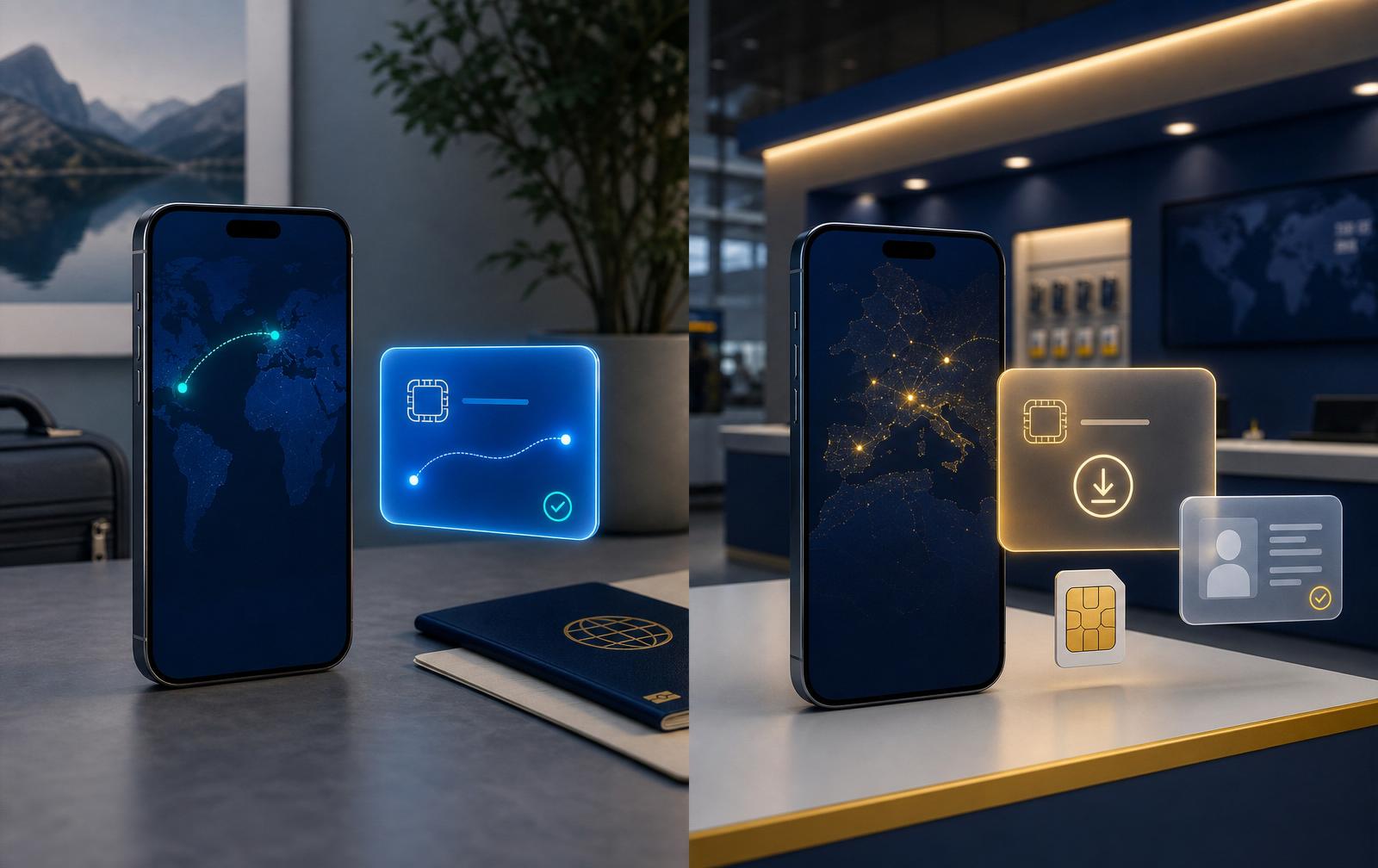
Travel eSIM journey
- Check phone compatibility and unlock status.
- Buy the destination or regional data bundle.
- Install or confirm the reusable eSIM profile.
- Prepare the data-line settings.
- Select the travel eSIM when the trip begins.
Local SIM journey
- Research destination providers.
- Find a supported purchase channel.
- Check required identification or registration.
- Purchase and activate the plan.
- Insert or download the local SIM.
- Configure calls, data and top-ups.
Will you need identification to buy a local SIM?
It depends on the destination, provider and type of plan. Some local providers require passport or identity registration, while others allow different online or retail activation processes.
- Requirements vary by country.
- Requirements can also vary by provider and sales channel.
- Airport, shop, kiosk, online and application purchases may follow different processes.
- A local address or local payment method may sometimes be requested.
- Travellers should use an authorised sales channel.
- Current requirements should be checked before relying on a local plan.
eSIMbundle does not require the traveller to complete an in-person local-provider SIM-registration process after arrival. Online account, payment, fraud-prevention, support and security information may still be processed.
Is a travel eSIM or local SIM cheaper?
There is no universal winner. A local SIM may offer strong local value, especially for a long stay or very high data use. A travel eSIM can be more valuable when immediate connectivity, preparation, multi-country coverage and avoiding local setup matter.
- SIM or activation fee
- Included high-speed data
- Validity period
- Top-up rules
- Calls and SMS
- Hotspot or tethering rules
- Multi-country coverage
- Registration requirements
- Support availability
- Currency and payment method
- Whether the plan fits the actual trip
A practical decision sequence
- Estimate the amount of data needed.
- Check how long the plan remains valid.
- Decide whether a local phone number is necessary.
- Compare the complete plan rather than only the data allowance.
- Check compatibility, coverage and hotspot rules.
- Include the practical value of being connected when you arrive.
Do you need a local phone number?
With an eSIMbundle travel eSIM
- The travel plan is generally data-only.
- It does not provide a local destination phone number.
- Internet calling and messaging applications can use the data connection.
- The home line can remain active on compatible dual-SIM phones.
- Home-provider charges may apply to activity on that line.
With a local SIM
- A local plan may include a destination number.
- Calls and SMS may be included.
- Some local visitor plans may still be data-only.
- Number validity and top-up rules vary.
- The number may stop working if the plan expires or the account is deactivated.
Can you keep your normal number while using either option?
Behaviour depends on the phone, the SIM format and how each line is configured.
With a travel eSIM
- The travel eSIM can be selected for mobile data.
- The home line can remain active for calls and SMS on compatible devices.
- Automatic mobile-data switching should normally be disabled.
- Home-provider charges can still apply.
With a local physical SIM
- A dual-physical-SIM phone may keep both physical lines.
- A phone with one physical slot may require removing the physical home SIM.
- A phone using the home line as an eSIM may be able to use a local physical SIM simultaneously.
- Device and provider support vary.
With a local-provider eSIM
- A compatible phone may use the local eSIM alongside the home line, subject to device and provider limits.
Both options still require a compatible unlocked phone
Every option relies on the phone supporting the required SIM format and the destination networks.
Travel eSIM
- eSIM support
- An unlocked device
- Support for destination networks and bands
- Available eSIM capacity
Local physical SIM
- A compatible physical SIM slot
- The correct SIM size
- An unlocked device
- Support for the provider’s network and bands
Local-provider eSIM
- eSIM support
- An unlocked device
- Provider support for the phone
- Eligibility under the provider’s activation rules
Check before buying
eSIM Compatibility Checker
Check whether the phone supports eSIM and review likely unlock status before choosing a travel eSIM.
A phone without eSIM support may still support a local physical SIM when it is unlocked and network-compatible.
Is a local SIM faster than a travel eSIM?
Not automatically. The SIM format does not determine speed. Real-world performance depends on the network, coverage, congestion, device bands, plan terms and network access.
- A local SIM may connect to its provider’s network directly.
- A travel eSIM may connect through one or more available partner networks.
- Direct local service does not guarantee higher priority or speed.
- A travel eSIM does not guarantee the fastest available network.
- 5G availability does not guarantee consistently higher real-world speed.
- Indoor and rural coverage can differ from city-centre coverage.
- Hotspot and fair-use conditions vary by plan.
Which option is easier for a multi-country trip?
A trip covering more than one country tests how well each option travels between markets.
Regional travel eSIM
- One bundle may cover several listed destinations.
- The reusable profile remains installed.
- A separate local plan is not required in every covered destination.
- Coverage must be checked before buying.
- Not every regional bundle covers every nearby country.
Local SIM
- A local plan is primarily designed for its home market.
- International or regional roaming depends on the provider.
- Another plan may be needed in another country.
- Existing allowance and validity may not transfer.
Which option works best for different trips?
Six concrete scenarios show how the trade-offs land on real trips.
Short holiday
A four-day city trip
- The traveller mainly needs maps, messaging and bookings.
- There is little value in arranging a separate local account.
- The phone supports eSIM and is unlocked.
A travel eSIM is probably the simpler choice.
Long stay
A two-month stay in one country
- The traveller expects substantial local use.
- A local number may be useful.
- There is enough time to compare authorised providers.
Compare local plans with a travel eSIM before deciding; the local option may better suit the longer stay.
Multi-country
A trip through four countries
- Repeated local-plan setup may be inconvenient.
- A regional bundle may cover the full route.
- Every destination must be checked before purchasing.
A regional travel eSIM is usually more convenient when the coverage fits.
Local number required
The traveller needs ordinary local calls
- eSIMbundle is generally data-only.
- Internet calling does not replace every local service.
- A destination provider may offer a local number and calling allowance.
A local SIM may be the better choice when a local number is essential.
No eSIM support
The phone is unlocked but has no eSIM support
- An eSIMbundle profile cannot be installed.
- The phone has a compatible physical SIM slot.
- Local physical SIM availability must be checked.
A local physical SIM is the practical option for this device.
Immediate arrival data
The traveller needs transport and maps immediately
- The travel eSIM was prepared before departure.
- Mobile-data settings were configured.
- The traveller does not need to find a specific shop first.
The prepared travel eSIM offers the clearest arrival experience.
Choose a travel eSIM or local SIM in seven questions
Answer these in order and the fit usually becomes clear.
- Does the phone support eSIM?
- Is the phone unlocked?
- Do you need a local phone number?
- How long will you stay?
- Are you visiting one country or several?
- How much mobile data do you expect to use?
- Do you want everything prepared before departure?
Travel eSIM is likely better
- Short or medium-length trip
- Connection prepared before arrival
- No local number required
- Compatible unlocked eSIM phone
- Several covered destinations
- Home line should remain available
- VPN access wanted
Local SIM is likely better
- Local phone number required
- Extended stay
- Heavy local calling or data needs
- Phone lacks eSIM support
- Local plan better matches the required allowance
- In-person provider support preferred
- Destination-specific services are important
The decision does not have to be permanent. A traveller can use a travel eSIM for arrival and later choose a local plan if the stay or requirements change.
Sources and further reading
Official device references and background reading used while writing this guide.
Understand how the wider internet experience changes abroad →
Prepaid travel data
Prepare your travel eSIM before you fly
Choose an eSIMbundle destination or regional bundle, install the reusable profile at home, and land connected. VPN access is included at no extra cost.
Frequently asked questions
Is a travel eSIM better than a local SIM?
It depends on the trip. A travel eSIM is often more convenient for preparation, short stays and multi-country travel. A local SIM may be better for a long stay, a local phone number or a destination plan that more closely matches the traveller’s data and calling needs.
Is a local SIM cheaper than an eSIM?
Not always. Local plans can offer strong value, especially for longer stays or heavy local use, but prices, fees, validity and included services vary. Compare the complete plan rather than assuming either option is automatically cheaper.
Can I buy a travel eSIM before departure?
Yes. An eSIMbundle data bundle can be purchased and the reusable eSIM profile prepared before travel. Activation and validity still follow the rules of the selected bundle.
Does a local SIM always require a passport?
No universal rule applies. Identification and registration requirements depend on the destination, provider and purchase channel. Check the current requirements of the local provider before relying on that option.
Does a local SIM always include a local phone number?
No. Many local plans include a destination number, but some visitor or data plans may be data-only. Confirm the calls, SMS and number features before purchasing.
Can I keep my normal phone number with a travel eSIM?
Yes, on compatible dual-SIM phones. The home line can remain available for calls and messages while the travel eSIM is selected for mobile data. Home-provider charges may still apply.
Can I keep my normal phone number with a local SIM?
It depends on the phone and SIM setup. Dual-SIM devices may keep both lines active, while a phone with one physical SIM slot may require removing a physical home SIM to use a local physical SIM.
Is a local SIM faster than a travel eSIM?
Not automatically. Speed depends on the network, coverage, congestion, device compatibility, plan terms and network access rather than whether the plan was purchased locally or for travel.
Is a travel eSIM better for several countries?
A regional travel eSIM can be more convenient when one bundle covers every destination on the itinerary. Check the complete coverage list before buying.
Can I use a local provider’s eSIM instead of a physical SIM?
Some local mobile providers offer eSIM plans. Availability, supported phones, registration and visitor eligibility depend on the provider.
Does eSIMbundle include a VPN?
Yes. VPN access is included at no extra cost with every eSIMbundle data bundle and can be used on supported mobile-data and Wi-Fi connections after it is turned on in the application.
